
A sliding screen door should move with ordinary one-hand pressure. If you have to yank the handle, lift the panel, twist its frame, or push through a hard spot, something is increasing friction or allowing one part of the door to touch where it should not.
The useful clue is not merely how hard the door feels. It is where and how the resistance develops. Dragging through the entire opening, catching at one repeatable location, and rubbing at one low corner point toward different conditions. Forcing the door erases that distinction and may push the panel farther out of alignment.
Start by moving it slowly and observing the resistance before cleaning, lubricating, adjusting, or removing anything. Most initial checks can be completed with the screen installed. The strongest first correction is the smallest reversible change that matches the movement pattern—not the most aggressive fix available.
The Likely Causes of a Sliding Screen Door That Needs Excessive Force
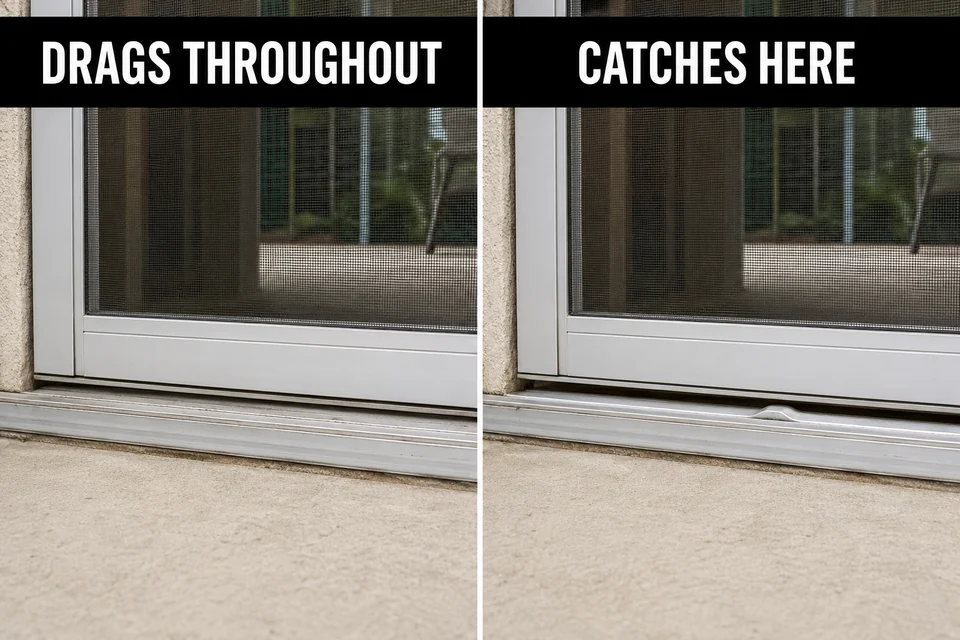
The first distinction is continuous drag versus a localized catch. Continuous drag usually means something is rubbing or resisting throughout the door’s travel. A catch that occurs at one repeatable location directs attention to a specific point on the track or a component moving with the panel.
Loose grit remains a common cause around an exterior patio opening. Pollen, pet hair, dried soil, leaf fragments, and compacted dirt can collect along the lower track. Material spread across the track can make the whole movement rough, while one small object may create an abrupt stop.
A reasonably clean track does not rule out lower-edge contact. Most lightweight sliding screen panels depend on small rollers and guides to hold the frame at the correct height. If the panel sits too low, its bottom rail can scrape the track instead of being carried cleanly across it. A long rub mark and a steady scraping sound support this diagnosis.
A roller may be contaminated, worn, damaged, or no longer rotating freely. Heavy movement alone, however, does not prove roller failure. Incorrect roller height, a sagging corner, or a panel that is no longer square can create almost the same symptom.
Localized resistance changes the diagnosis. A dent, raised joint, loose section, or damaged spot in the track normally creates a catch at approximately the same place on every pass. Resistance concentrated near the closed position can instead come from the latch, handle, side frame, guide, or weather strip.
Thin aluminum screen frames can also lose their original fit after being struck or repeatedly pulled sideways. Heat may make an already tight opening feel worse, but temperature alone is rarely a complete diagnosis. More often, it exposes clearance that was already marginal.
Checks to Make Without Removing the Entire Assembly
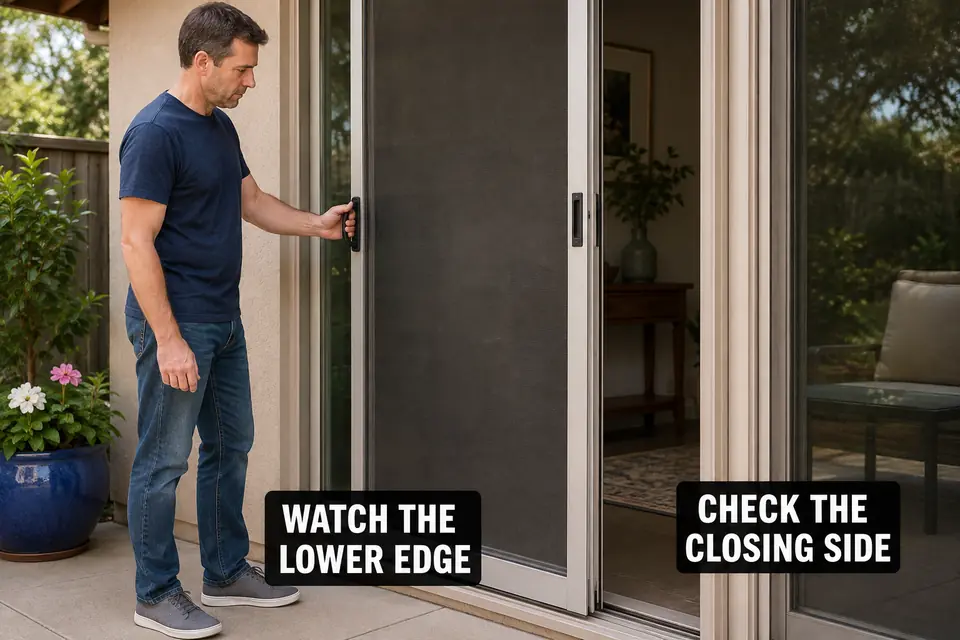
Do not change anything until you can describe the resistance pattern. Move the door slowly from fully closed to fully open using the handle and normal pressure. Record mentally whether the resistance is constant, begins partway across, or appears only near one jamb. Repeat the movement once to confirm whether the hard point stays in the same place.
Listen as well as feel. A steady scrape supports broad surface contact. Grinding or rough vibration can indicate debris or a roller that is not traveling smoothly. A click or impact at one repeatable position points more strongly toward a localized obstruction, track defect, or interfering component. Sound supports the diagnosis, but it should not name the failed part by itself.
Watch the lower rail during movement. It should remain reasonably parallel to the track rather than dipping noticeably at one corner. Then observe the closing edge for contact with the jamb, latch, handle, guide, sweep, or folded weather strip.
Inspect the accessible track in good light, concentrating on the location that corresponds with the catch. Look for loose material, compacted dirt, a raised joint, a dent, a loose fastener, or a sharp damaged edge. Do not run bare fingers through a narrow metal track.
With the door stationary and securely guided, give the handle only slight upward support as you begin a short movement. If the panel becomes easier to move immediately, you have evidence of a clearance, support, or roller-height condition. You have not yet proved that a roller needs replacement.
Warning Sign: Stop if the panel twists, begins leaving its guide, encounters sharp track damage, or requires increasing force to remain in motion. An unstable lightweight panel should not be pushed through repeated tests.
How to Identify the Part or Fit Condition Behind the Symptom
The strongest diagnosis connects two clues: where the resistance occurs and whether the problem stays with the opening or travels with the door. One clue without the other can send you toward the wrong repair.
Resistance Across Most of the Opening
Continuous resistance points toward continuous friction. The lower frame may be rubbing, contamination may extend along the travel path, or a roller may not be turning freely. Look for a long scrape mark, widespread debris, or consistently poor clearance beneath one portion of the panel.
If slight upward support makes the door noticeably easier to move across most of the opening, the problem likely involves load or clearance. That narrows the field to roller height, corner support, or roller operation, but it does not distinguish adjustment from component damage.
A Catch at the Same Location
A catch at the same point in the opening directs attention to the stationary track. Inspect that point for a dent, raised seam, embedded fragment, loose section, or fastener interfering with travel.
The useful cross-check is whether the catch remains tied to that location. If the symptom instead follows the same corner of the moving panel, the likely source travels with the door. A roller, lower-frame contact point, or attached piece of hardware then becomes more plausible than a stationary track defect.
Dragging at One Edge
One low corner points toward unequal roller height, frame sag, or a panel that is no longer square. Resistance near the latch side may come from closing-side alignment rather than the rollers.
A door that became stiff after an impact deserves particular caution. Adjustment may recover a small amount of clearance, but it cannot reliably correct a visibly twisted frame or damaged opening.
Field note: A door becoming easier when lifted is diagnostic evidence, not a workable operating method. Continuing to lift it by the handle can distort the frame and conceal the unresolved support problem.
The Lowest-Risk Correction to Try First
The first correction should test the diagnosis without creating a second variable. Change one visible, reversible condition, then move the door again before doing anything else.
If loose debris aligns with the resistance, remove it and clean only the affected accessible area well enough to test the result. Do not assume the entire track needs a separate restoration project.
If a flexible sweep, guide, or weather-strip edge is visibly folded into the travel path, return it to its intended seated position only when it is accessible and undamaged. Retest immediately.
Some sliding screen doors provide accessible roller-adjustment screws, but their position and adjustment direction vary. Confirm that an opening is actually an adjuster for your door model. Mark the starting position or count the movement so it can be reversed, make one small change, and test again.
Do not adjust the panel until it barely remains in the guides. It needs enough clearance to avoid rubbing while remaining securely engaged at the top and bottom. If the adjuster resists normal hand-tool pressure, stop rather than forcing it.
The common quick fix—coating a dirty exposed track with a general-purpose oily lubricant—can retain more grit and temporarily mask the contact pattern. Use only a treatment approved for the specific component and door system.
Hammering the track, bending the frame by hand, or pulling harder are not low-risk corrections. Visible deformation, sharp damage, a loose track, or an unstable panel requires a condition-specific repair.
Repeat-Failure Clues That Point to a Different Cause
A correction is supported only when it improves the original resistance without creating a new one. Move the door through its full path several times using ordinary hand pressure. It should remain stable, stay inside its guides, and close without being lifted or forced against the jamb.
If the same catch returns at the same track location, the area may be damaged rather than dirty. Repeated cleaning will not correct a raised joint, dent, or loose track.
If a lower corner begins dragging again soon after a small adjustment, the adjustment may not be holding, the frame may be sagging, or a worn roller may be allowing the panel to settle. A door that works only while being lifted still has an unresolved support or clearance problem.
Resistance shifting to another part of the opening is equally important. The first change may have moved the panel without restoring a correctly aligned fit. Stop making successive blind adjustments; every extra change makes the original relationship between the frame, rollers, and track harder to interpret.
The practical success standard is uncomplicated: the screen door should travel through the complete opening under normal one-hand pressure without lifting, twisting, grinding, or being pushed through a catch. If it cannot do that—or cannot remain securely guided—the result points to a deeper condition rather than a need for more force.
Adjustment arrangements vary between screen-door systems; Andersen’s official documentation, for example, identifies model-specific screw locations and directions in its gliding insect screen roller instructions.