
A sliding screen door that repeatedly comes off its track is not merely difficult to move. It is losing the support or retention that should keep the panel captured between its upper and lower tracks. Putting it back may restore movement for a moment, but it does not correct that loss of engagement.
The useful clue is what happens immediately before the door escapes. One corner dropping, the panel climbing at the same location, and the entire door feeling loose are three different failure patterns. Treating all three as “bad rollers” can lead to an adjustment that changes the symptom without fixing it.
Keep the screen installed for the first inspection. Most useful clues can be observed while moving it gently by the handle, provided the panel is stable enough to inspect safely.
The Likely Causes of a Screen Door That Repeatedly Jumps or Falls Out of Its Track
The location and direction of the escape matter more than how easily the panel can be placed back. Typical U.S. patio screen doors use a lightweight aluminum frame with small rollers or guides. The exact hardware varies, but the panel must remain sufficiently engaged throughout its travel.
One Lower Corner Escapes First
When the same lower corner repeatedly drops or jumps out, begin with the support and frame condition at that corner. Its roller may sit too low, bind instead of turning, shift inside a loose housing, or fail to hold its adjusted position. A separating frame corner can create almost the same symptom by allowing the panel to twist.
A single-corner escape does not prove that the roller needs replacement. The roller may remain intact while its adjustment, surrounding frame joint, or relationship with the track has changed.
Resistance matters when it appears just before the corner rises. If the screen rubs along most of its route or needs excessive force even while it remains engaged, compare that behavior with a sliding screen door that is hard to open. Continuous drag is a separate primary symptom, although it can eventually make a lightweight panel climb out.
The Door Drops or Tilts as a Whole
When both lower corners appear poorly seated, look beyond one isolated roller. Excessive clearance, incorrect roller height, loose upper guides, or a panel that no longer fits the opening correctly can leave the entire door inadequately captured.
A screen that lifts noticeably during ordinary handle movement is not securely engaged. Increasing roller height may help on an adjustable design, but adjustment should not be used to disguise a missing guide, distorted track, or damaged frame.
It Comes Out Near the Same End of Travel
A repeatable escape point shifts the diagnosis toward that part of the track. Packed debris, a raised fastener, a separated joint, a dent, or a bent edge can push the roller or lower frame rail upward.
The defect does not have to look dramatic. A brief upward force can dislodge a lightweight panel when its normal engagement is already shallow. This is different from a screen that escapes unpredictably along the opening, which points more strongly toward general looseness or frame movement.
Normal Handling Still Produces Random Derailment
A door that escapes at different locations despite slow, straight movement may be changing shape as it travels. Loose aluminum frame corners can let the panel rack from a rectangle into a slight parallelogram. That diagonal shift unloads one roller while pressing the opposite corner into the track.
The common mistake is to keep lifting and forcing the panel back into place. That can spread loose joints and erase the original movement clue without restoring reliable support.

Checks to Make Without Removing the Entire Assembly
The first inspection should reproduce the movement, not the fall. Start with the screen closed or resting squarely in the opening. Confirm that neither lower corner is already hanging outside the track, then move the panel slowly using only the handle.
Warning Sign: Stop if the panel is hanging from one corner, sharply twisted, or likely to fall. Do not place fingers beneath its lower edge or support it with your foot. Keep the opening out of use until the panel can be stabilized safely.
Watch Which Edge Moves First
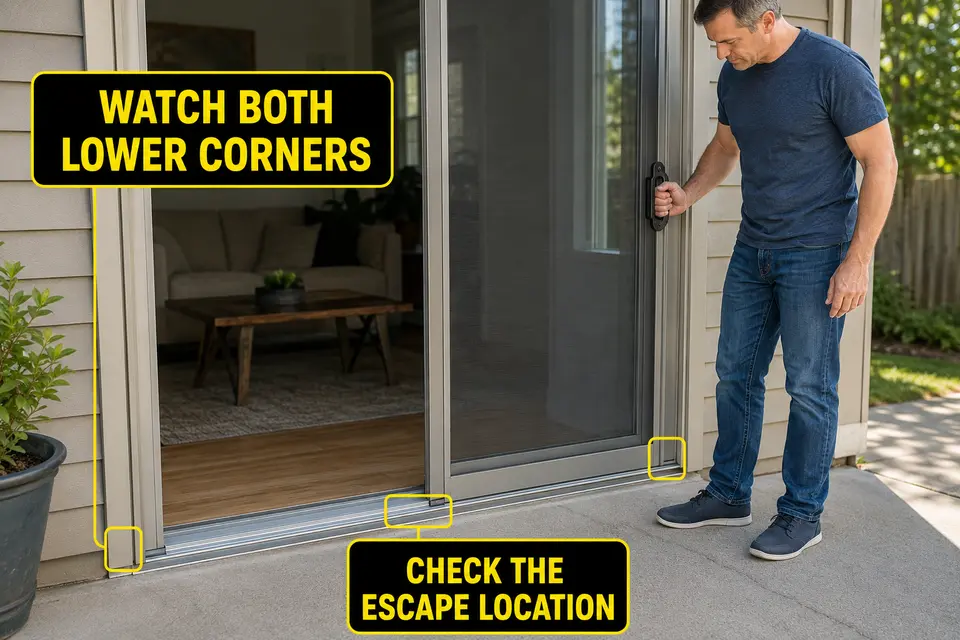
Move the door through only part of its travel. Watch both lower corners rather than focusing only on where the panel eventually leaves the track.
A corner that rises before escaping suggests that the track or another fit condition is lifting the panel. A corner that drops without first climbing points more toward lost support, a loose adjustment, or frame movement.
Repeat the observation from the opposite direction. The door may remain stable while opening but escape while closing because a roller encounters the same track defect from a different angle.
Inspect the Accessible Track and Retaining Edges
With the panel stationary, inspect the visible lower track for packed dirt, stones, raised screw heads, dents, separated joints, and bent lips. Remove only loose material that can be cleared without scraping, grinding, or reshaping the track.
Look at the accessible upper retaining area as well. Depending on its design, the screen may use guides, springs, rollers, or frame clearance to stay captured. An obviously missing or displaced piece matters, but do not reach into concealed hardware or assume every door uses the same arrangement.
Compare the visible fit near the beginning, middle, and end of travel. A larger gap near one end may explain where the door escapes, but diagnosing why the full opening is out of alignment belongs to a dedicated frame or track assessment.
Check for Looseness Without Forcing the Panel
Use only the force normally required at the handle. Watch whether the rectangular panel twists, a frame corner opens, or the upper and lower edges stop moving together.
Do not shake the door to test it. Lightweight screens normally have some flex, but ordinary operation should not open their corner joints or allow one side to leave its track.
How to Identify the Part or Fit Condition Behind the Symptom
A useful diagnosis combines movement, location, and visible condition. No single clue should be treated as proof of a failed component.
When One Corner Points Toward Support Loss
If the same corner sits low, moves unevenly, and escapes at different points, support at that corner becomes the leading concern. An intact, accessible adjustment may permit a small correction when the panel is stable and the adjustment point’s function is clear.
Change only enough to determine whether engagement improves. Stop if the adjustment feels stripped, seized, or already at its limit.
When a Repeatable Location Points Toward the Track
If either corner rises at the same location, inspect that section before changing the entire door height. Clearing loose debris is a reasonable first correction; trying to compensate for a bent or broken track is not.
Raising the whole panel enough to clear one defect can reduce its engagement elsewhere. The door may pass the original point and then begin escaping at another.
When Excessive Panel Play Points Toward Retention
A screen that feels loose throughout its route may not be adequately captured between its lower support and upper retaining area. Roller position, displaced guides, worn hardware, or changed track alignment could all produce that condition.
Return an accessible guide to position only when it remains intact and its correct location is unmistakable. Do not improvise retainers, bend the frame, or force one adjustment to compensate for a missing component.
When the Door Changes Shape During Travel
If a corner joint opens or the panel visibly racks during gentle movement, roller adjustment cannot restore structural stability. The frame is no longer holding the geometry that keeps both sides engaged.
A distorted panel can look correctly seated while stationary and unload one corner as soon as it moves. Further adjustment may relocate the failure rather than correct it.
When Adjustment Will Not Rescue a Failed Part
Adjustment stops making sense when a component can no longer support or retain the panel. A roller that is broken, seized, loose in its housing, or unable to hold its setting has crossed that boundary.
The same applies to a missing or deformed guide, a split or sharply bent track lip, a frame corner that repeatedly opens, or adjustment hardware that is stripped or corroded solid. A panel that remains visibly bowed or racked also needs more than a height correction.
Keep the screen out of regular use if ordinary handle movement can lift it free or if it derails again after one careful correction. Repeated falls can damage the mesh, spread the frame corners, and turn a limited hardware failure into a panel-level repair.
How to Test the Screen Door After Each Change
The result is not “the door moved once.” The result is whether it remains captured during repeated normal travel without being lifted, steadied, or guided by hand.
- Return the screen to a stable position and confirm visually that both lower corners are engaged.
- Move it slowly through part of its travel while watching the corner that previously escaped.
- Complete several gentle full-length passes using only the handle.
- Open and close it at a normal household pace without slamming, lifting, or pushing sideways on the frame.
- Stop if it rises, twists, catches at the same point, develops new looseness, or leaves the track again.
Test from both directions. If the failure moves to another location, the change altered the fit but did not restore secure engagement. Do not stack another adjustment on top of a result you have not interpreted.
A successful correction keeps the panel captured repeatedly under normal use. If it escapes again, the useful next move is not another quick reseating—it is repair of the roller, guide, track, or frame condition identified by the movement pattern.
For a manufacturer-specific example of treating screen installation, track cleaning, and roller adjustment as separate checks, see Andersen’s gliding insect screen care guidance.