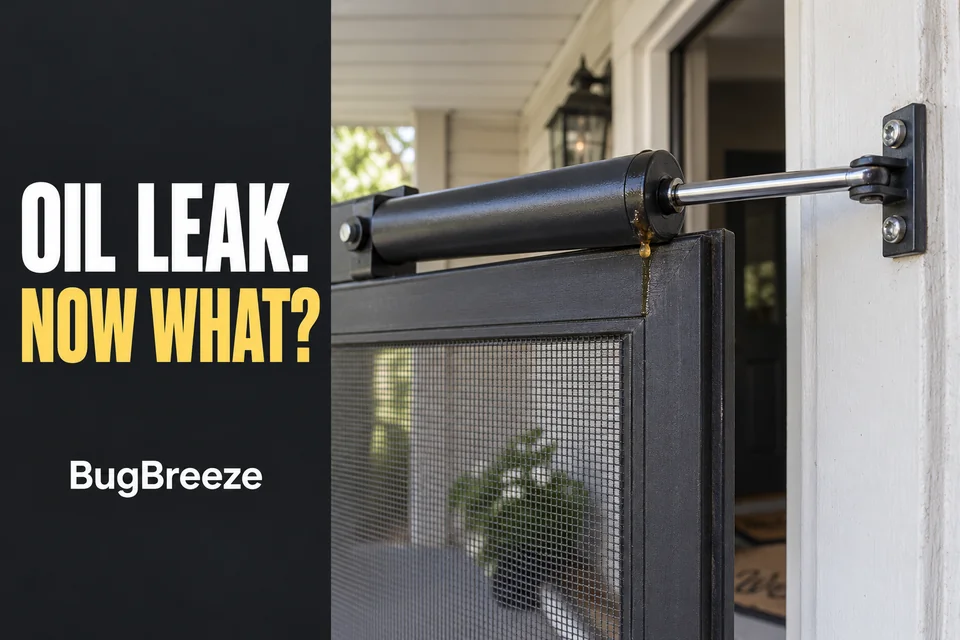
A small oil bead can be enough to justify replacing a hydraulic screen-door closer. The decision turns on whether fresh fluid keeps appearing and whether the exact model has a documented service option.
Recurring fluid loss from a sealed residential hydraulic closer generally points toward replacement. A limited repair is reasonable only when the manufacturer specifies one. Wiping the cylinder or changing the closing speed does not establish that the leak has been repaired.
First, confirm hydraulic operation using the model information or documentation. A tubular appearance alone does not distinguish hydraulic equipment from pneumatic equipment. Then separate leftover surface lubricant from fluid that repeatedly appears at the same location. That distinction determines whether you have established an active leak.
The Repair-or-Replace Decision for Visible Fluid Loss From A Hydraulic Closer
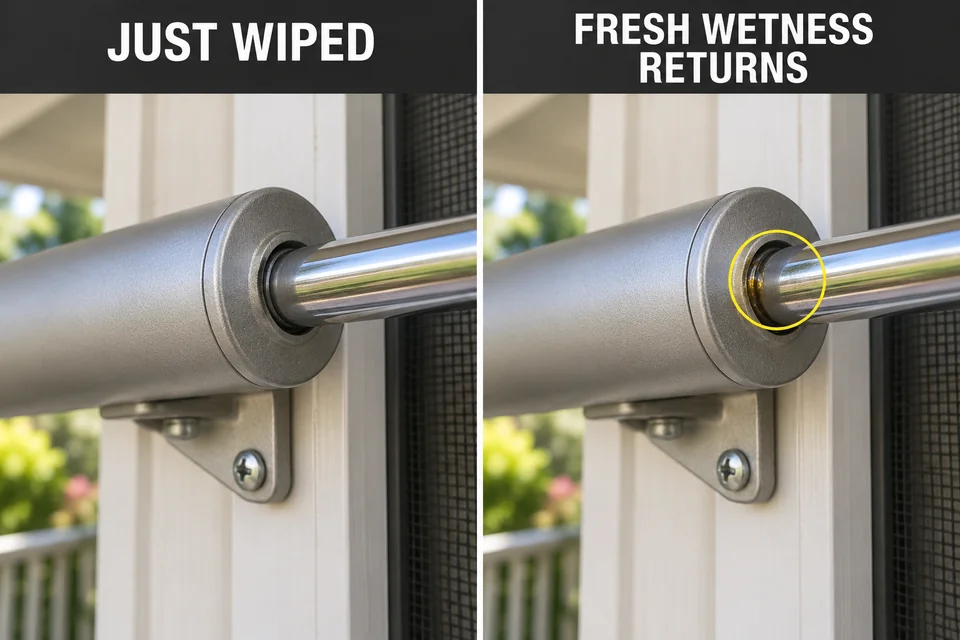
Choose observation only while the source remains uncertain and the door stays controllable. Wipe accessible exterior wetness with a cloth, then watch for renewed wetness during ordinary, controlled operation. Keep fingers clear of moving hardware. Do not remove a pin, open the cylinder, or loosen a screw to investigate.
A surface that looks dry immediately after wiping tells you only that it has been cleaned. A fresh bead returning at the rod entry, body joint, or adjustment area is stronger evidence of continuing loss. Its location is useful information, but it does not identify the exact internal part that failed.
| Observed condition | Decision implication | Appropriate path |
|---|---|---|
| Residue is removed, no renewed wetness is observed, and closing remains controlled | Active loss has not been established | Observe without declaring the unit repaired |
| Fresh wetness returns on a sealed unit | Cleaning has not addressed the source | Replace the closer |
| The exact model has a documented external service procedure | A limited repair may be possible | Follow the manufacturer’s service route |
| Leakage accompanies uncontrolled closing, damaged attachments, or inaccessible hardware | Routine homeowner correction is insufficient | Stop testing and obtain assistance |
Closing behavior affects how urgently you act. If the screen door slams shut, do not keep cycling it simply to produce another visible drip. Slamming alone does not prove hydraulic leakage, but slamming alongside recurring fluid loss is enough reason to stop relying on the closer.
Professional help can be part of a replacement decision. You may already know the leaking unit needs replacing while still needing someone to address damaged mounting points or difficult access.
Signs a Small Repair Is Still Reasonable
A small leak does not automatically mean a small repair. Even a recurring bead can emerge from a location with no homeowner-serviceable parts. Repair eligibility comes from the model’s service instructions, not the amount of oil on the outside.
When the wetness does not return
If the residue clears and does not reappear during subsequent ordinary use, active leakage remains unconfirmed. Previously applied lubricant or another surface contaminant may have created the original wet appearance.
Observation avoids replacing a unit before establishing the problem. Its limitation is uncertainty: a single dry inspection cannot establish long-term fluid containment. Recheck the accessible area during normal use, and change course if fresh wetness appears or closing behavior deteriorates.
This is cleanup and observation, not a repaired hydraulic fault.
When the manufacturer specifies an external repair
A genuine repair exception needs documentation for the exact model. The instructions must identify the serviceable component, approved procedure, and any required replacement part. They must also permit homeowner service before the work can reasonably be treated as DIY.
A straight exposed rod, intact cylinder body, firm attachments, and controlled closing support considering that documented option. They do not prove the internal mechanism is healthy.
Without an approved service route, avoid experimenting with whichever screw happens to be nearest the wetness. Tightening a mounting screw might correct a loose attachment, but it does not restore fluid containment. Likewise, an adjustment screw is not automatically a leak-repair fastener.
A Temporary Fix Versus a Durable Correction
Judge a correction by whether fresh fluid returns and closing stays controlled. A clean cylinder or one slower closing cycle is too little evidence to call the problem resolved.
Wiping oil from the closer and threshold manages the mess. Tape around a body joint, exterior sealant near the rod entry, or lubricant applied to the rod does not restore internal fluid containment. These measures can also obscure where fresh wetness is appearing.
Changing the closing-speed setting may alter door movement, but it neither replenishes lost fluid nor demonstrates that a leak has been repaired. Do not tighten or remove an unidentified screw in pursuit of a temporary improvement.
After documented service or compatible replacement, check for both renewed wetness and controlled closing during subsequent normal use. A repair that leaves either problem unresolved has not delivered a durable result.
If closing becomes uncontrolled, keep the door out of normal unattended use until it is addressed. Disconnecting the closer or leaving the door propped open is not a universal temporary solution; either changes how the door behaves and can introduce another problem.
Cost, Appearance, Downtime, and Repeat-Failure Tradeoffs
For a sealed unit with recurring leakage, repeated troubleshooting adds cost without creating a service option. Compare the complete job: compatible parts, installation, mounting corrections, and the chance of having to do the work again.
A manufacturer-approved external repair may preserve the existing hardware and avoid new mounting marks. Its value depends on confirmed serviceability, available parts, and the condition of the rest of the closer. Before altering or discarding the unit, record its model information and check whether warranty support applies.
Replacement offers a clearer path when the existing unit cannot be serviced, but compatibility matters more than a matching finish. A similar-looking cylinder may require different brackets, mounting positions, or fasteners. Changing the arrangement can leave old holes or unpainted areas visible.
The door and mounting surface matter too. A lightweight screen door and a heavier glazed storm door may have different closer requirements. Painted wood jambs, aluminum frames, and vinyl-clad assemblies do not automatically accept the same attachment method. Existing holes lining up is insufficient evidence that a replacement is suitable.
Downtime depends on obtaining the correct part and finding sound mounting points. An accessible, documented replacement may be straightforward; damaged attachments can turn it into a larger job. Avoid choosing an incompatible substitute solely because it is immediately available.
Repeat failure changes the calculation again. If a replacement also leaks, or its rod or bracket becomes distorted, compatibility, binding, and mounting geometry deserve attention before another cylinder is installed. A new unit cannot correct an unresolved installation problem.
The Point Where DIY No Longer Addresses the Cause
Recurring loss from a sealed closer marks the limit of exterior treatment. Replacement may still be a homeowner task when the correct unit is identified, instructions are available, mounting points are sound, and the door can be handled safely.
The boundary changes when the installation itself needs correction. A bent rod, distorted bracket, visible attachment gap, torn mounting area, or concealed mechanism calls for further assessment before a cylinder swap. These observations do not prove why the oil leaked, but they identify additional conditions that need attention.

If the closer rod or bracket keeps bending, that recurring deformation needs its own assessment. Replacing the leaking unit while leaving the mechanical problem unresolved may lead to further damage.
Use professional assistance when hardware is inaccessible, mounting repairs are needed, or you cannot control the door safely during the work. The job may involve correcting the installation and fitting a replacement rather than rebuilding the leaking closer.
Once recurring loss is established and no documented repair exists, further exterior treatment has reached its limit. The remaining decision is whether a compatible replacement can use the sound existing installation—or whether the mounting problem needs correcting as part of the same job.