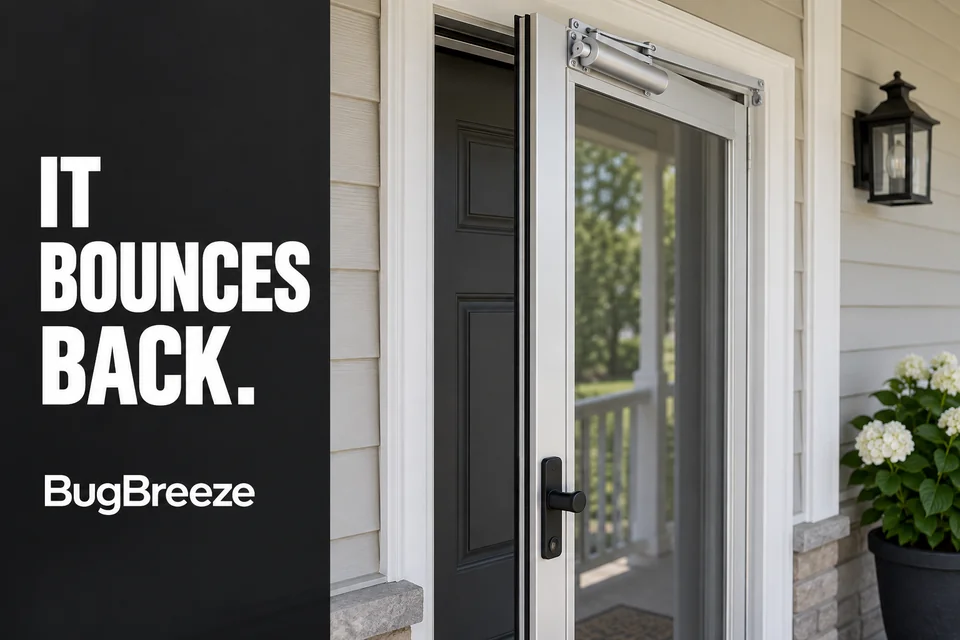
Your storm door swings toward the frame, nearly closes, then comes back open. Before changing the closer setting, compare its behavior with the primary entry door closed and open. That single change helps separate resistance from air trapped between the doors from a problem with closing control.
Keep the storm door’s starting position and settings unchanged. If opening the primary door consistently reduces the rebound, pressure contributes to the symptom. If the same fast approach and impact remain, closer action deserves attention. Both conditions can occur together, so one successful closure is not enough to declare the problem fixed.
The Likely Causes of Storm Door That Rebounds Instead Of Latching
Watch whether the reversal starts before or after contact. A door that slows near the frame and eases backward makes pressure-related resistance worth checking. A door that strikes the closing surface sharply and bounces away makes closing speed and control especially relevant.
Also separate reversal from a simple stop. If the door pauses short of closure and stays there, the diagnosis for a closer that stops before the door latches is the more appropriate starting point.
With the primary entry door closed, the approaching storm door displaces air into the space between the two doors. If that air cannot escape readily, pressure can resist the final movement. A glazed storm door may therefore behave differently from its intended ventilating configuration.
The closer controls the approach to that resistance. Excessive speed can produce an impact, while inconsistent control makes the closing cycle unpredictable. Air between the doors and air controlled inside a pneumatic closer play different roles. Adjusting speed may change the closing behavior, but it does not create an escape path for air between the doors.
Checks to Make Without Removing the Entire Assembly
Make the comparison before adjusting or disconnecting anything. Removing a closer pin changes the mechanism you are trying to observe and can leave the door uncontrolled.
- Choose calm conditions and clear the swing path. Keep children and pets away from the opening. Avoid testing during gusts that could push or pull the door.
- Check the accessible hardware visually. Confirm that the hold-open feature is released. Look for a bent exposed rod, damaged connections, or a bracket that shifts as the door moves.
- Test with the primary entry door closed. Open the storm door to an ordinary, repeatable position and release it without adding a push. Watch whether it slows, strikes, reverses, or latches.
- Repeat with the primary entry door open. Secure that door clear of the test. Use the same storm-door starting position and leave every closer setting unchanged.
- Compare repeated cycles. Look for a consistent change in the final approach and rebound, rather than relying on one successful closure.
Stop if a mounting bracket moves, its supporting surface pulls away, or the door becomes difficult to control. Those observations need attention before another closing trial.
If the assembly remains secure, use the handle to guide the storm door gently toward closure with the primary door open. Keep fingers away from the edges. A repeatable hard catch is a reason to stop; do not push through it. This observation helps distinguish free movement from a separate fit problem.
An improvement during the open-door test supports a pressure contribution without proving that the closer is fault-free. Unequal starting positions, an added shove, or a passing gust can hide that distinction.

How to Identify the Part or Fit Condition Behind the Symptom
Choose the next action from the change you observed. A repeatable improvement when the primary door opens carries more diagnostic weight than the loudness of the bounce. Persistent impact still needs interpretation: fast free movement and a hard mechanical catch are different findings.
| Observed result | What it supports | Next action |
|---|---|---|
| Rebound consistently improves with the primary door open | Pressure between the doors contributes | Check the model’s intended ventilation guidance before changing closer settings |
| Fast approach and impact persist, but gentle closure has no hard catch | Closer speed or control deserves attention | Inspect for damage, then follow the correct closer-adjustment instructions |
| Rebound improves but does not disappear | More than one condition may contribute | Address the pressure-sensitive behavior and reassess remaining closer motion |
| A hard catch persists during gentle, controlled closure | A separate fit or latching problem needs diagnosis | Stop this adjustment path; do not force the door through the catch |
When Opening the Primary Door Changes the Result
Consistent improvement makes the space between the doors part of the problem. Leaving the primary door open, however, is only a test condition.
If your storm door has an intended ventilating glass or screen configuration, consult its operating instructions. Where appropriate, use that existing feature to investigate whether ventilation changes the behavior. Do not cut weatherstripping, drill holes, or create permanent gaps to release air.
If the door has no suitable ventilation feature, ask the manufacturer about the pressure-sensitive closing condition. Avoid compensating by making the door hit harder: a setting that overcomes resistance with the primary door closed may produce a slam when that door is open.
When the Closer Still Needs Attention
If the hardware is intact and secure, gentle closure reveals no hard catch, and the door approaches too quickly in both conditions, check the closer’s adjustment instructions. For a compatible conventional cylinder, the procedure to adjust pneumatic closer speed can support this next step.
Identify the model and change one permitted setting at a time. Screw direction, adjustment range, and final closing action vary across systems. A speed adjustment should not be treated as a universal spring-force adjustment, and the adjustment screw must remain installed.
Dual-closer and concealed-closer systems need their own instructions. Do not disconnect one cylinder or assume both units should receive matching turns. After each permitted change, repeat the comparison with the primary entry door closed and open.
Partial improvement is useful evidence. If opening the primary door reduces the reversal but excessive closing speed remains, address that remaining behavior before accepting the result.
When Adjustment Will Not Rescue a Failed Part
Visible damage ends the routine adjustment path. A bent rod, damaged attachment, or bracket that moves under load needs attention even if another screw setting seems to improve closure temporarily.
Keep mounting damage separate from closer failure. Movement at an attachment does not prove the cylinder needs replacement, and replacing the cylinder alone will not restore an insecure connection. Speed adjustment cannot correct either condition.
If correctly performed, model-specific adjustments leave closing speed uncontrolled, the closer needs further assessment. If speed is controlled but a hard catch remains, return to the fit boundary instead of assuming internal closer failure.
Identify the door and its closer arrangement before selecting a replacement, particularly where two closers work together. Leave the assembly connected while arranging the appropriate repair rather than experimenting with disconnected components.

Repeat-Failure Clues That Point to a Different Cause
Judge the correction with the primary door closed—the condition that may have exposed the problem. Observe several ordinary closing cycles without pushing through the final gap, then open the primary door and check that the storm door remains controlled.
Once the latch appears engaged, use a gentle opening pull without operating the handle to confirm that it holds. A door that looks closed but immediately pulls open has not passed the result test.
If an adjustment makes the screen door slam shut when the primary door is open, revisit the setting using the model’s instructions. Accepting impact to obtain latch engagement leaves the closing behavior unresolved.
Rebound that returns specifically when the primary door closes points back toward pressure sensitivity. A change after switching between intended glass and screen configurations is another useful clue, though it is not proof by itself. Wind-dependent behavior should be reassessed on a calm day before changing hardware again.
The correction must work with the doors configured as you normally use them. Keep it only when the storm door closes under controlled motion and stays latched, without developing a slam when the primary door opens. Continued rebound or a required extra push means the problem remains; use the observed pressure response or hardware condition to guide the next service question.
Andersen’s guidance on storm doors that do not fully close with the entry door closed explains why airflow between the doors belongs in this diagnosis.