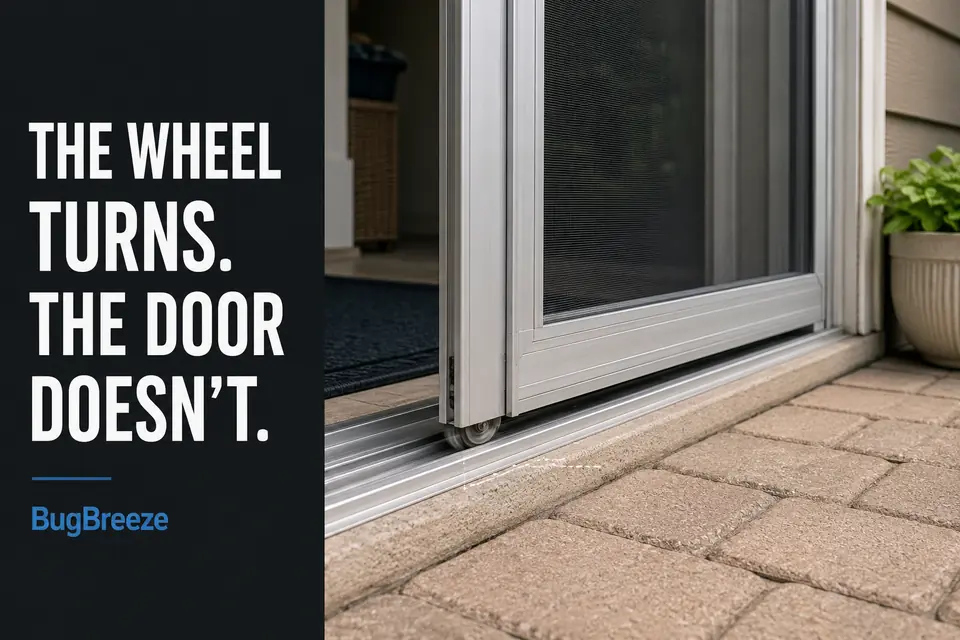
A screen door roller can turn freely and still do none of the work that matters. Rotation proves only that the wheel can spin. It does not prove that the wheel is properly seated, supporting the panel’s weight, or responding to its adjustment mechanism.
The useful diagnosis comes down to load transfer. A working roller must maintain stable track contact, support its corner of the panel, and convert rotation into door movement. If one of those results is missing, more adjustment is not automatically the answer.
Keep the door installed and contained in its upper and lower channels during the initial checks. If the panel has already left the track completely, this is no longer the right diagnostic path.
The Likely Causes of a Roller That Turns Without Carrying the Door
The first distinction is whether the roller is spinning under load or merely brushing the track. An unloaded wheel can rotate as the panel moves while carrying too little weight to guide or raise its corner.
This can happen when the roller is adjusted too far into the frame, sits against an edge instead of the intended running surface, or has shifted within its mounting position. The visible movement looks convincing, but the low corner reveals that the wheel is not doing useful work.
Wear produces a similar symptom through a different mechanism. A wheel with a reduced effective diameter may still rotate smoothly but no longer extend far enough below the frame to support the panel. A damaged tread can also create intermittent contact: the corner hesitates, remains low, or moves only when some of the panel’s weight is temporarily relieved.
The adjustment mechanism can fail independently of the wheel. An adjustment screw may turn while a worn, stripped, bent, or incorrectly seated carrier stays in the same position. Repeated turns then create activity at the screw without producing a height change at the door.
A small piece of material exactly where the wheel meets the track can interrupt contact as well. That is different from a generally dirty track. Here, the relevant clue is a localized obstruction directly beneath or beside the affected roller.
Recent installation is another strong possibility. If the symptom appeared after removal, reinstallation, or adjustment, the wheel may be sitting against the side of the track rather than squarely on its running surface.
Field Check: Keep your fingers out from beneath the installed panel, and do not force the corner upward with a pry bar. Stop if the inspection requires aggressive lifting or the door cannot remain safely contained in its channels.
What Changed Before the Symptom Started
The timing of the failure often separates wear from an installation or adjustment error. Gradual loss of support favors wheel or carrier wear; an immediate change after the door was handled favors incorrect seating or ineffective adjustment.
Consider the last event before the symptom appeared. Was the door lifted during cleaning? Was one corner adjusted to correct a drag? Did the panel receive a bump or twist during forceful closing? An abrupt post-work symptom should be treated differently from a corner that settled progressively over several months.
Location adds another filter. One affected lower corner points toward that roller or its contact point. If both corners lost support after reinstallation, the whole panel may have been seated incorrectly. If one corner remained low immediately after adjustment, return to the complete roller-height adjustment sequence before assuming that additional screw turns will solve it.
A symptom that occurs only at one location along the track is also different from a roller that stays unloaded throughout its travel. The wheel may carry the door normally until it reaches one raised, damaged, or obstructed area.
How to Separate Alignment, Wear, Debris, and Installation Causes
The useful test is not whether you can make the wheel spin. It is whether the wheel maintains the correct contact position while the door’s weight is resting on it.
Start with the panel stable in its normal installed position. Compare the affected lower corner with the opposite corner under the same conditions rather than judging the troubled roller in isolation.
Watch where the roller meets the track
Move the door gently through a short section of travel. A correctly engaged wheel should remain centered on its intended running surface while supporting the corner. It should not brush an edge, wobble beside the track, or lose contact as the panel begins moving.
An alignment problem is likely when the wheel turns but rides against the side of the track or changes contact position during travel. An installation problem becomes more likely when that behavior began immediately after the panel was removed or reseated.
Wear is more likely when the roller follows the correct path but the corner stays low despite available adjustment. Visible flattening, chipping, excessive sideways play, or a wheel that no longer extends far enough beneath the frame strengthens that diagnosis. Because the carrier may remain hidden, do not name a precise internal failure until the hardware can be properly inspected.
Localized debris should appear at the exact point where the wheel loses contact. A pebble, hardened residue, or small fragment can lift or deflect the roller momentarily. Dirt spread along the entire track does not, by itself, explain this specific symptom.

Test whether adjustment changes the panel
Mark the starting adjustment position before making one small change. Then watch the corner—not the screwdriver or screw head. A functioning adjustment must visibly change how the wheel contacts the track or how high the corner sits.
If the screw turns but the corner does not respond, stop. That result is more diagnostic than another turn: the carrier may be worn, damaged, incorrectly seated, or no longer transferring adjustment to the wheel.
If the panel remains consistently low on the same side throughout its travel, compare that broader pattern with a screen door that continues to drag on one side. That condition may involve uneven panel support rather than a roller that simply spins without carrying the door.
If the panel leaves its lower track or escapes either guide during the test, stop the inspection. A displaced or repeatedly derailing panel belongs to a different repair path.
The Lowest-Risk Correction to Try First
The first correction should be the smallest reversible change supported by the observations. Repeatedly turning the adjustment screw before confirming track contact can hide the original position without fixing the mechanism.
- Confirm that the panel is contained. Both the upper edge and lower rollers must remain within their intended guides. Stop if the panel leans out or will not remain stable.
- Remove only a visible localized obstruction. Clear a small object if it is directly interrupting the affected roller’s contact point. Do not turn this into a general track-cleaning procedure.
- Check the roller’s running position. The wheel should sit on the intended surface rather than against an edge. Do not force it sideways with a tool.
- Make one controlled height change. If contact is stable but the corner remains low, adjust from the marked starting position and watch for an actual change in height.
- Test normal travel. Move the door through its usable range. The roller should remain loaded without forcing the panel against the upper channel.
A correction has worked only when the affected corner rises or stabilizes and remains supported as the panel moves. Easier screw movement or continued wheel rotation is not enough.
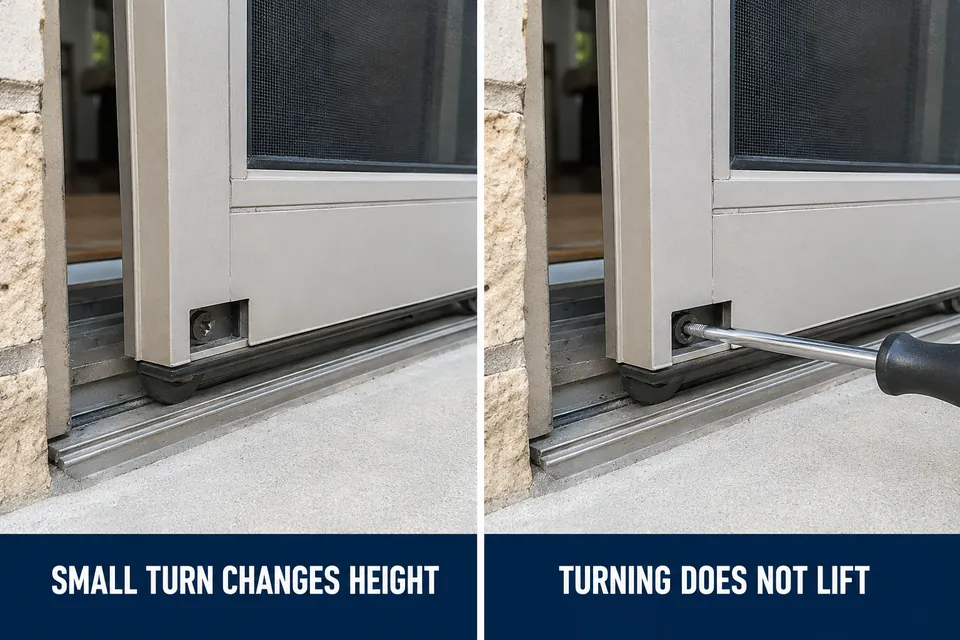
If a small adjustment restores stable contact, test that result before changing anything else. Large or repeated blind turns can raise the panel until its top edge binds against the upper guide, exchanging one movement problem for another.
Stop when the screw rotates without changing the corner height, the wheel will not remain centered, or the panel must be lifted forcefully to maintain contact. Those responses place the problem beyond a routine installed-door correction.
Repeat-Failure Clues That Point to a Different Cause
A temporary improvement is not a successful repair. The adjustment must continue supporting the panel through several complete opening and closing movements.
Watch the affected corner near the starting position, through the middle of travel, and near the opposite end. It should remain supported without scraping below or binding against the upper channel.
Rapid height loss after an apparently successful adjustment points toward a mechanism that cannot hold its setting, a worn carrier, or a roller shifting out of position under load. That recurrence is more useful diagnostically than the initial rise.
A screw that continues turning without creating a lasting height change marks the correction boundary. More adjustment cannot compensate for a stripped mechanism, damaged wheel, bent carrier, or incorrectly installed assembly. Those conditions require closer hardware inspection and may require panel removal, which falls outside this diagnosis.
If the roller carries the door everywhere except at one location, inspect that precise track area rather than blaming the entire roller system. If the same corner remains low throughout travel, the one-sided-drag diagnosis is the stronger fit. If the panel repeatedly leaves its path, follow the guidance for a screen door that keeps coming off its track instead of repeatedly reseating or readjusting it.
Judge the roller by the load it carries, not the motion you can see. The repair is complete only when the wheel maintains contact, supports the corner, and moves the door without creating pressure at the upper guide. If that relationship does not hold, the spinning wheel is still only a symptom.
For broader U.S. consumer guidance on recognizing and reporting unsafe household products, consult the U.S. Consumer Product Safety Commission.