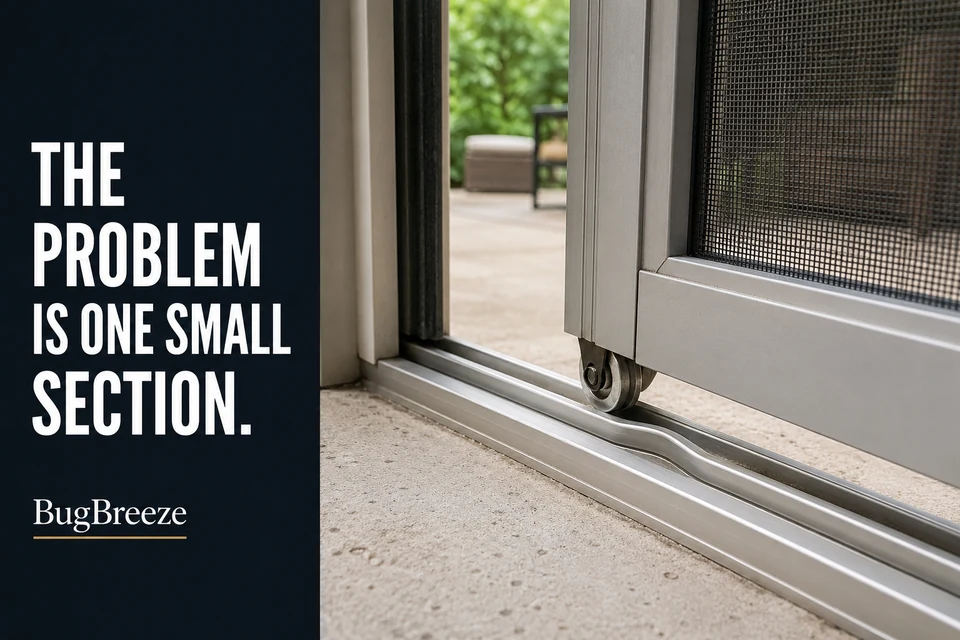
The useful repair target is not a track that looks perfectly straight. It is a track profile that lets the roller pass without being pinched, lifted, or pushed sideways.
That distinction matters because a small aluminum bend often invites too much correction. Direct hammering may flatten the visible dent while narrowing the roller path or creating a longer wave beside it. The safer sequence is to confirm that the damage is local, record the original geometry, support the rail, make one small correction, and test before doing more.
This procedure applies only to a short bend or dent in a lightweight aluminum screen-door track. It excludes cracked metal, a loose threshold, widespread bowing, full track replacement, and the heavier rail carrying a patio glass door.
Preparing for Locally Dented or Bent Aluminum Screen-Door Track
The first decision is whether the visible damage is suitable for an in-place correction at all.
Confirm which rail carries the screen panel, then move the screen slowly toward the suspected spot. A localized bend should cause a repeatable bump, scrape, or sideways deflection at the same track location. If resistance continues across much of the opening and no short deformation is visible, start with the broader reasons a sliding screen door becomes hard to open.
Remove only enough grit to expose the aluminum. Compare the suspect area with the undamaged track beside it and determine how the profile changed:
- One wall is pushed into the roller path.
- A narrow channel is pinched inward.
- An exposed rail leans sideways.
- A short edge rises into the roller’s path.
Mark the beginning and end of the deformation with removable tape or pencil. This limits the working area and reveals whether later pressure moves the dent or bends a longer section.
Wear gloves and eye protection. For a modest correction, the useful items are a work light, smooth wood blocks, non-marring padding, and either a light rubber mallet or a suitable hand tool with protected contact surfaces. A long tool list does not improve the repair; close support and restrained force do.
Stop before applying force: Do not straighten aluminum that is cracked, torn, separating from the threshold, sharply creased with visible whitening, or moving at its mounting points. Stop as well if the deformation extends well beyond the marked area.

What to Inspect Before Releasing or Removing Anything
Preserve the original relationship between the roller and track before changing either one. Removing the panel or adjusting hardware too early erases the baseline needed to judge the repair.
Move the panel toward the marked area from both directions. Note where resistance begins and whether the same roller contacts the same point. Then inspect the adjacent undamaged profile for its normal channel width, wall angle, and rail height. A small wood reference fitted loosely to the undamaged opening can preserve that comparison, but it must never be driven into the track as a wedge.
Also check:
- Whether the damaged section remains firmly attached.
- Whether nearby screws or joints distort the profile.
- Whether trim or a threshold cover restricts movement.
- Whether drainage openings remain clear.
- Whether the roller stays captured as it approaches the bend.
- Whether both sides of the deformation can be supported safely.
If the same door corner stays low across the entire opening, the problem is more consistent with a screen door dragging on one side than with one damaged track point.
Remove the screen panel only when it blocks safe access, leaves a roller directly over the work area, or could receive the correction force. Record its orientation and starting height first. Keep a removed panel upright on a protected surface, and use a helper if its size makes it difficult to stabilize.
How to Protect the Frame, Finish, and Surrounding Parts
Correction force should stop at the dent. If the rail is unsupported, that force can travel into the straight aluminum and replace one short bend with a longer wave.
Pad anodized, painted, or coated surfaces before placing a tool against them. Position a smooth wood backer close behind the deformation without bearing against the glass-door rail, drainage opening, adjoining trim, or frame corner.
Match the support to the defect:
- Back a leaning rail from the side opposite the correction.
- Support a raised edge below or beside it where access permits.
- Protect both walls of a channel so one is not pushed into the other.
- Keep sharp steel edges away from finished aluminum.
The common mistake is gripping both walls and squeezing until the track looks straight. That may improve its appearance while making the roller opening narrower. Direct blows against an unsupported rail create the same problem in a different direction.

Clearance, Tension, or Movement Checks During the Work
Use a correction-and-test cycle, not one large attempt. Each small change must improve both the track profile and roller movement before another is made.
- Begin at the outer edge of the bend. Correct where the track first leaves its normal line rather than forcing the deepest point immediately.
- Support the opposite side. Keep the wood backer close to the active area and verify that the straight track beside it is not flexing.
- Make one restrained correction. Use protected hand pressure or a light tap through the supporting block. Do not strike the aluminum directly.
- Recheck the profile. Compare rail height, sidewall angle, and channel width with the adjacent undamaged section. Look for a new pinch point beside the original dent.
- Test movement slowly. Move the installed panel through the area at low speed. Stop if the roller lifts, drops, binds, or kicks sideways.
- Continue only while movement improves. Stop when the roller passes smoothly and remains captured. A harmless cosmetic wave does not justify additional force.
New whitening, a sharp crease, cracking sounds, mounting movement, or strong spring-back marks the end of a reasonable homeowner correction. Increasing force after the profile stops improving is more likely to fatigue the aluminum than restore it.
Do not change roller height during this cycle. That moves the contact point and makes the track result harder to judge. If the rail is stable afterward but the panel remains uneven, treat adjusting the sliding screen-door rollers as a separate job.
The Final Test Before Calling the Repair Complete
Success is determined by repeatable roller travel, not by one clean pass or a perfectly straight-looking rail.
Remove temporary marks, padding, and loose debris. Inspect the corrected area in side light for a sharp edge, new inward bulge, raised fastener, crack, or separation from the threshold.
Move the panel through the repair slowly once. If that pass is clean, complete several full opening-and-closing cycles with normal hand pressure. Confirm latch operation only after travel is stable; changing the latch or roller position earlier can hide an incomplete track repair.
Final repair checklist:
- The roller passes the corrected point without a repeatable impact.
- Channel width closely follows the undamaged track beside it.
- Both rollers remain captured through several full cycles.
- No crack, looseness, or new deformation is visible.
- The screen closes and latches without being lifted or forced.
Recheck the area after several normal uses. If the panel still climbs out at the same point, the track may remain distorted in another direction or the door may have a separate containment problem. Follow the dedicated diagnosis for a sliding screen door that keeps coming off track instead of repeatedly bending the same aluminum.
Once smooth, stable travel returns, stop. Further cosmetic straightening adds risk without improving the way the door works.