
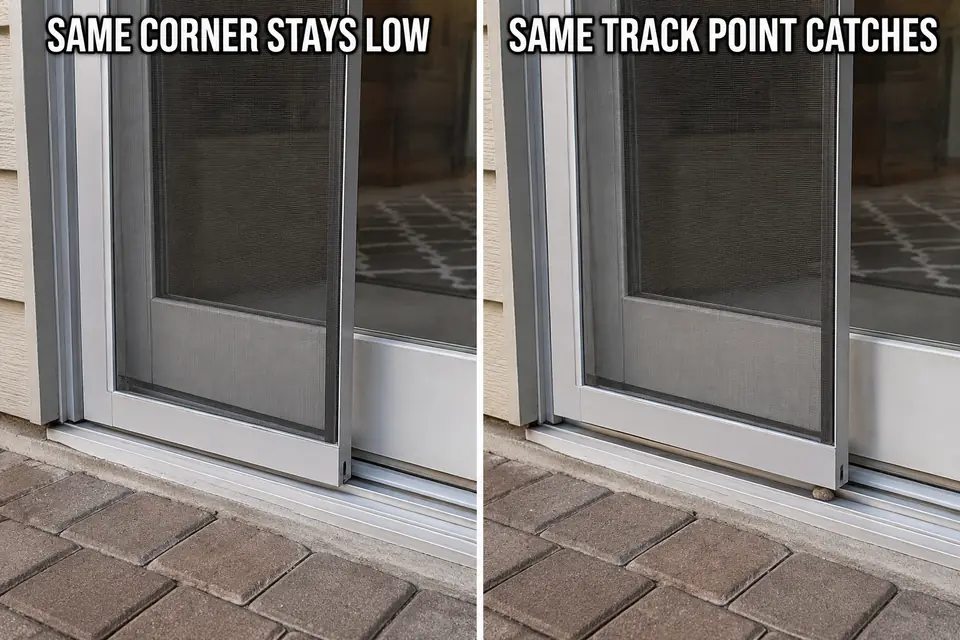
When a sliding screen door drags at one lower corner but moves freely at the other, the uneven behavior is the diagnostic advantage. The useful question is not simply why the door feels rough. It is whether the contact follows that corner as the door moves or occurs at one fixed place on the track.
That distinction separates a door-corner problem from a track-location problem before any adjustment is made. Do not begin by raising the panel or forcing it past the contact point. Move it slowly by the handle and watch where the lower edge loses clearance.
The Likely Causes of One Lower Corner Dragging While the Opposite Side Moves Freely
A corner that remains low throughout the door’s travel usually points to uneven support. Its roller may be set lower than the opposite roller, may no longer roll freely, or may have lost effective height through wear. The panel can also sit slightly out of level even when both rollers still function.
Do not treat scraping noise as proof of a broken roller. Fine grit around the wheel, uneven adjustment, or a panel that was not seated correctly after removal can create nearly the same symptom. Where the contact occurs is more reliable evidence than the sound alone.
A different pattern appears when the door moves normally for most of its travel but catches at the same place each time. A small stone, compacted dirt, damaged track edge, or raised fastener can interfere with the passing corner. Raising the door in this situation may hide the symptom temporarily while leaving the obstruction untouched.
Field Check: Do not force the door through a stubborn spot. Continued pushing can pull a lightweight screen panel out of square or cause a lower corner to escape the track, obscuring the original symptom.
What Changed Before the Symptom Started
Timing does not identify the failed part, but it changes what should be checked first. A sudden symptom after patio work, track cleaning, or a windy day with the screen open favors a new obstruction. Dirt, bark fragments, grit, or a small stone can enter an otherwise straight track and affect only the corner passing over it.
A problem that begins immediately after the panel was removed and reinstalled points more strongly toward uneven seating or altered roller height. One corner may not be fully guided, or a previous adjustment may have left the two ends at different heights. Check the installed position before assuming a component failed during removal.
Gradual worsening makes wear, a shifting adjustment, or slowly reduced clearance more plausible. Seasonal temperature changes can influence aluminum and vinyl assemblies, but season alone is not a diagnosis. The controlling evidence remains whether contact follows the door corner or stays tied to one track location.
How to Separate Alignment, Wear, Debris, and Installation Causes
The most useful test keeps the door installed and compares two locations at once: the moving corner and the stationary track. Stand where you can see the lower edge without placing fingers or tools beneath the panel. Move the screen slowly by its handle, note where contact begins, and then repeat the pass.
If the same lower corner remains close to the track from one end to the other, compare its clearance with the opposite corner. A consistent difference favors uneven roller support, corner-specific wear, or panel alignment. If scraping appears only at one physical point, inspect that section for loose debris, compacted dirt, a bright rub mark, or visible displacement.
| Observed behavior | Cause to prioritize | What it does not prove |
|---|---|---|
| The same corner drags throughout travel | Uneven support, alignment, or corner wear | It does not automatically prove a broken roller |
| The drag occurs at one track point | Debris or a localized track condition | It does not automatically justify raising the door |
| The symptom began after installation | Uneven seating or installation alignment | It does not prove the track is damaged |
| The drag gradually worsened at one corner | Wear or lost height becomes more plausible | It does not identify the failed part |
Judge the symptom across the entire opening rather than concentrating on the first scrape you hear. If resistance continues through most of the door’s travel, the condition no longer fits this localized diagnosis. The door may have broader track contamination, excessive guide tension, or resistance involving both ends.
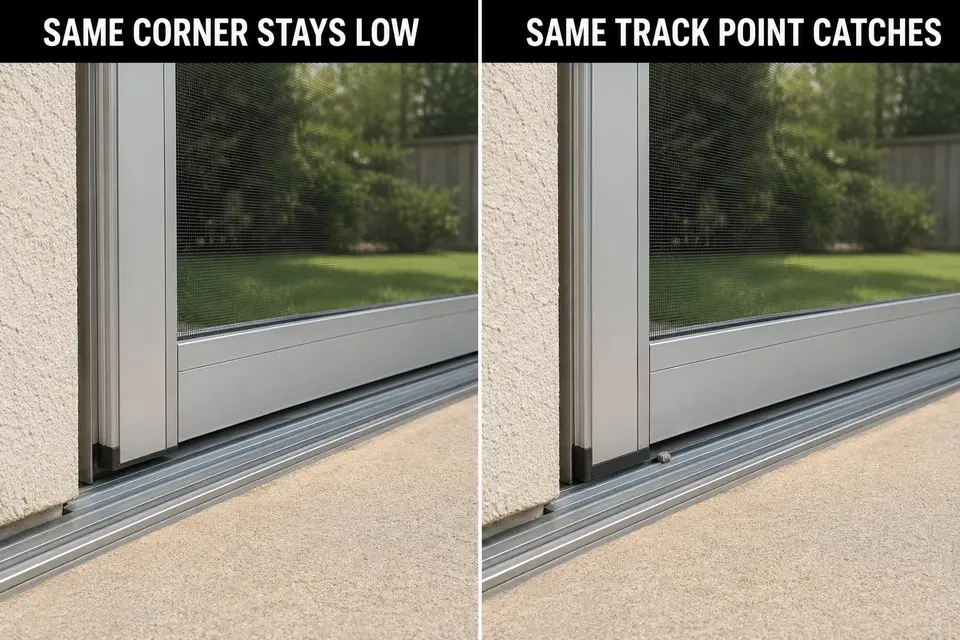
Dragging must also be separated from loss of retention. A corner that merely sits low remains guided as the panel moves. If the same lower corner repeatedly leaves the track, stop treating the condition as simple drag. Roller tension, track retention, panel fit, or damaged hardware may require a different inspection.
Visible track bending, a loose frame joint, grinding from inside the corner, or a panel that cannot remain securely guided marks the repair boundary. Cleaning and minor adjustment should not be used to compensate for structural damage.
The Lowest-Risk Correction to Try First
Correct the fixed surface before changing the moving panel. Vacuum or lift out loose material from the identified track area, then wipe the surface with mild soapy water and a soft cloth or brush. Dry the track and test the door again. Avoid abrasive cleaners or metal tools that can damage thin aluminum.
If the catch disappears, no height change is needed. If it repeats at exactly the same location after cleaning, inspect that point in good light. A visibly raised, cracked, or sharply bent section is not a debris problem and should not be forced flat while the door remains loaded against it.
When the same corner stays low throughout the opening, confirm that the panel is seated correctly and both lower corners remain guided. If it is secure and otherwise usable, mark the starting position before changing its height. That reference lets you reverse the change if top clearance or track retention becomes worse.
For a confirmed height imbalance, follow the complete process to make a controlled roller-height adjustment. Change only the affected fit condition in small increments rather than raising the entire panel simply because one corner scrapes.
Stop once the corner clears the track. Excessive height can press the upper edge into its guide, increase resistance, or leave too little engagement below. If the adjustment does not respond normally, the corner grinds internally, or the panel becomes loose in either guide, return to the starting reference and move to repair evaluation.
Lubricant is not a universal answer. A wet or oily product can collect grit on an exposed patio track, and no lubricant can correct uneven seating, damaged track geometry, or a worn roller. Clean first and use only a product specified by the door manufacturer where its instructions call for one.
How to Test the Screen or Door After Each Change
A correction is complete only if it removes the drag without creating a different fit problem. Move the door through its entire usable travel several times at a normal pace, then make a slower pass through the former contact area. One unusually smooth pass is not enough.
Watch both lower corners. They should remain guided without climbing, dropping, or shaking at the former drag point. Check the upper edge as well: removing the lower scrape by forcing the panel against the upper channel has merely moved the interference.
The door should remain reasonably level and stay where placed instead of rolling noticeably toward one end. Close it normally to confirm that the change did not disrupt its basic fit, but do not turn this check into latch-side diagnosis.
If contact returns at the same track point, return to the fixed-location diagnosis. If the same corner remains low everywhere, retain the corner-specific diagnosis instead of repeatedly cleaning an already clear track. The right stopping point is a freely moving panel that remains securely guided without new binding above.
For manufacturer guidance supporting track cleaning before roller work, see Andersen’s instructions for adjusting or replacing gliding insect-screen rollers.