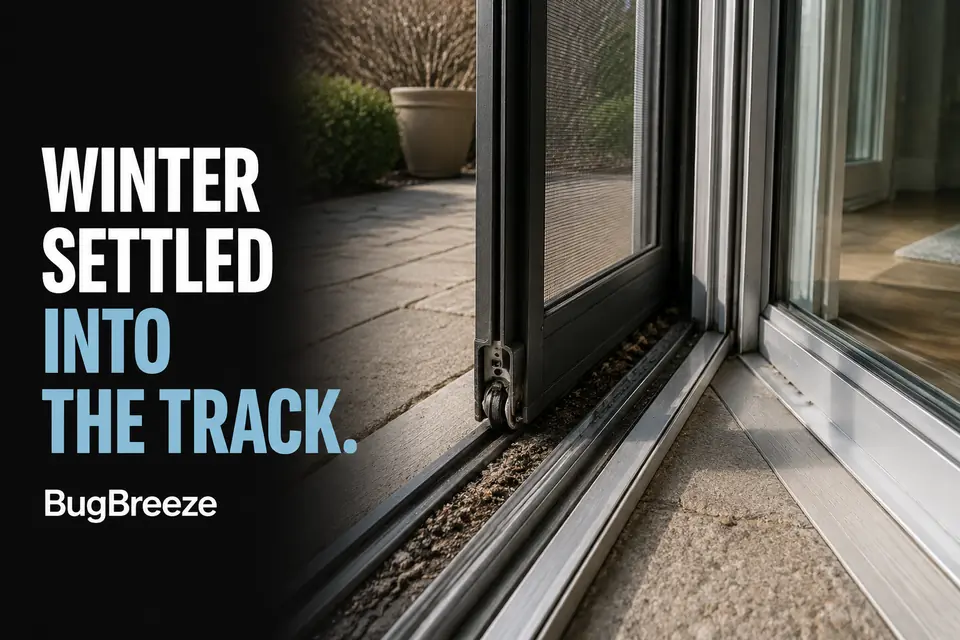
Cleaning a screen-door track after winter is mainly an order-of-operations problem. Loose sand may sit on top of dried salt, while repeated door movement presses both into the roller path. If water goes in first, the grit becomes abrasive slurry. If the door is worked repeatedly before cleaning, the rollers can compact the debris more firmly.
The useful sequence is dry extraction first, controlled moisture only where residue remains bonded, and movement testing only after the channel is clear and dry. That sequence protects the lightweight aluminum and preserves an honest baseline. If the door still resists afterward, the remaining symptom can be judged without dirt disguising its cause.
Preparing for Seasonal Grit, Salt, And Compacted Debris In A Screen-Door Track
The first decision is whether the material is loose, bonded, or concealing damage. Do not treat all three conditions with the same tool or pressure.
Position the door so part of the lower screen track is accessible while the panel remains safely engaged in both channels. Loose sand, soil, and leaf fragments should move beneath a soft brush. Salt film and dried splash deposits normally remain attached. Dark material compressed into the roller line may contain both.

Use the following order:
- Observe the undisturbed track. Note where debris is concentrated and where the door previously slowed. Before continuing, confirm that the obstruction looks like contamination rather than cracked or deformed aluminum.
- Extract loose material while it is dry. Use a vacuum crevice attachment and soft brush to lift grit from the channel. Work toward the vacuum opening rather than pushing debris into frame joints. Continue until brushing no longer releases visible particles.
- Apply limited moisture to bonded residue. Dampen only the affected areas with mild soapy water. Allow a few minutes for the deposit to soften, but do not flood the threshold or let the solution dry back onto the track.
- Release and lift the softened material. Use soft bristles or a smooth plastic or wood detailing edge. Apply only enough pressure to separate the deposit, then wipe it away instead of pushing it into a corner.
- Wipe and dry the channel. Use a lightly dampened clean cloth to collect the remaining film, followed by an absorbent dry cloth. Do not move on while standing water or loosened particles remain.
- Test without adjusting anything. Remove every tool and cloth, then move the door slowly. If the roller exposes another compacted strip, stop and clean that section before judging the result.
What to Inspect Before Releasing or Removing Anything
Inspecting first keeps track damage from being mistaken for stubborn dirt. It also preserves the original position of the door, which is needed for a meaningful movement comparison later.
Check the roller’s running line, both channel corners, lower frame joints, drainage openings, and the transition between the screen track and adjacent glass-door channel. Look for:
- A sharp crease or narrowed section of aluminum
- A crack extending from a contact point
- A lifted fastener or loose track insert
- Displaced weatherstripping
- A hard fragment wedged beneath a roller
- Coating damage or corrosion staining that does not release like residue
Do not increase scrubbing pressure just because a mark remains stationary. If cleaning exposes a localized deformation, treat it as a visibly bent screen-door track rather than attacking it with a harder tool.
Keep the panel installed when the accessible track can be cleaned normally. Backing out adjustment screws or releasing the door changes its position and erases the starting reference without improving the cleaning result.
How to Protect the Frame, Finish, and Surrounding Parts
Protecting the assembly means controlling where the grit and moisture travel. A gentle tool still causes damage if it drags sand across the finish or pushes residue into a frame joint.
Place absorbent cloths along nearby interior flooring or finished threshold surfaces, but keep them outside the roller path. Vacuum before introducing moisture. Once loose grit is gone, apply mild soapy water directly to the remaining residue rather than pouring it along the entire channel.
Use a soft brush for irregular corners and a smooth plastic or wood edge for a compacted strip. Hold the edge nearly parallel to the channel and use restrained pressure. Metal scrapers and wire brushes can gouge lightweight aluminum, while high-pressure spray can carry dirty water into joints and neighboring channels.
Lift released material onto a cloth or into the vacuum path. Do not push it toward a drainage opening. Finish with a sparing clean-water wipe and remove the moisture immediately.
Common setup-order mistakes
- Wetting loose grit first creates an abrasive slurry.
- Forcing a hard tool against the rail can turn residue removal into track damage.
- Flooding the threshold moves contamination into corners that are harder to inspect.
Clearance, Tension, or Movement Checks During the Work
Use movement as a test, not as a cleaning method. Repeatedly rolling over the obstruction only compacts material and makes the result harder to interpret.
Remove the vacuum attachment, brush, cloths, and loosened fragments before moving the door. Slide it slowly across the cleaned area without lifting, twisting, or pulling the panel sideways.
The first movement may uncover a strip previously hidden beneath a roller. Stop with that area accessible and inspect it before completing another pass. Resistance that shifts to newly exposed debris still belongs to the cleaning sequence.

Where the resistance remains is more useful than whether the door feels generally better. Drag that stays with the same lower corner after the entire track is clear may indicate a one-sided screen-door problem rather than overlooked dirt.
Do not alter roller tension during this test. Adjustment may change how the panel crosses the affected area, but it also removes the clean before-and-after comparison.
Allow the channel to dry, then test the complete opening. If resistance remains broadly distributed rather than repeating at one contaminated location, continue with the diagnosis for a sliding screen door that remains hard to open.
What to Recheck Before Trimming or Tightening
A clean track is the point where mechanical judgment begins—not evidence that mechanical adjustment is automatically required. Inspect the full roller line in strong daylight after it has dried, including channel corners, transitions, and drainage openings.
Before altering anything, confirm:
- The roller path is visibly clean and dry.
- No cloth fibers, brush bristles, or loosened fragments remain.
- The door completes several slow cycles without being forced.
- A catch does not repeat at the same track location.
- Latch alignment and upper-channel engagement remain unchanged.
Do not trim weatherstripping, tighten accessible hardware, or change roller height to compensate for a questionable first test. Those actions address different conditions and should occur only after the clean track has isolated the remaining symptom.
If the panel now moves freely and consistently, stop—the seasonal cleaning is complete. If the track is clear but the panel’s height is demonstrably wrong, handle sliding screen-door roller adjustment as a separate operation with its own starting reference.
The strongest result here is not a door that was adjusted until it felt better; it is a clean, dry track that reveals whether any adjustment is needed at all.